"My mind isn't what it used to be, I forget things" is something my mother frequently tells me when she's frustrated that she can't remember an event, a person, what she had for breakfast that morning, or more recently, how to describe a fountain that she had just seen. I can't even imagine what it's like to know something is wrong, but not know what.
As I've mentioned before, the 'what' is Alzheimer's and because of our history of a loved one with this disease, I don't think we've ever used the word Alzheimer's with my mom, at least I know I haven't.
What would be the point of telling my mom why she 'forgets' things? It's not going away. It's not going to get better.
And yet, in the midst of all this, I am amazed at what still resides in her memory ... like knitting.
I don't remember my mom being an avid knitter when I was growing up. I know she knit out of necessity - mittens, hats. At this point I have no way of asking her when she learned to knit, or who taught her. And I'm pretty sure she didn't teach me. Knitting was not something you saw my mom do often. If she was knitting, it was because something needed to be knit.
It was product, not process, that drove the knitting.
Fast forward to the present. My mom knits.
Constantly.
Ask her why and she'll tell you it's because she has always enjoyed knitting. It makes her happy and keeps her busy.
At this point, it's process that's important more than the product.
Because the product is ... well ... um ... we're not entirely sure.
She casts on as many stitches as the needle will hold and then just knits, dropping stitches as she goes, randomly adding others. In the end what you have is a skein of yarn that has become rows and rows of garter stitch but not much else. Except that it has made her happy to work with pretty yarn, and she's content in the belief she's doing something useful.
Often, when I visit, we sit and unwind what she's knit. She holds the knitted piece, I wind the ball. When I ask why we were doing it, she just smiled and says "Because we're having fun." To her, just being with me, sharing the time, is what is important now. It has become part of the process.
So while she forgets people, places, and events from her past, for now she remembers me and she remembers knitting. I visit, we sit, we knit. And sometimes we rip out and rewind what she's knit, but that's ok.
It's part of the process ...
And we're having fun.
Monday, September 30, 2013

Saturday, September 7, 2013
If the Sweater Fits...
I knit shawls. Lots of them. In different shapes and colors. The number of shawl patterns I have is obscene and I keep finding more I want to do. Really! It's a sickness ...

I have yarn to do socks and I have a lot of yarn in sweater quantities for ... wait for it ... sweaters. Other knitters in my local store are more versatile in their projects - a sock here, a shawl there, a sweater now and again.
But I seem to be stuck on shawls. And I finally think I've figured out why.

A shawl always fits. If it's too small, it's a shawlette. Too large? Maybe a throw. You kinda can't go wrong with a shawl.
I've made a pair of socks. I am still waiting for Big Foot to claim them
A sweater? In the past month I've watched no less than three knitters try on sweaters that were closer to completion than they were to beginning. As they got ready to put the sweater on, the rest of the us held our breath. We all knew what was coming. We all knew this was a moment of truth. And we all knew what it feels like when it becomes obvious that what you're doing isn't working. All that work, now what?
So we watched, holding our breath, crossing our fingers ...
Only one of those knitters was able to continue, the other two tried to figure out how to make what they'd done better. Seems there's really no way to make a sweater that's too small get bigger. Or stretch a too tight bind-off that makes the front of the cardigan shorter than the rest of the hem.
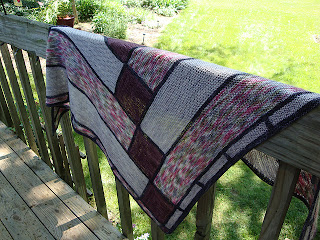 Believe me, in the hopes that the fit was only an optical illusion, making it fit was tried. Yank here, pull there. Even the delusion 'that S#!T will block right out' wasn't convincing. The only thing that was going to work was ripping back and redoing. And potentially ripping back and redoing ... again.
My guess is that both of those sweaters are currently in time out until the knitters have the heart to face them again. As of last night, the third sweater was almost done.
The stress of moving my mom closer and keeping up with work and home has been, um, not good for my weight. Ice cream? Yes, please! Potato chips? You bet! Salad? Yeah, not so much.
 So while I have a sweater's worth of yarn, I don't know that I have a sweater's worth of yarn for one that would fit me right now. And I really couldn't face spending all that time knitting only to find out I didn't have enough.
Life's too complicated at the moment. Knitting is my happy place.
For the time being? I'll knit shawls. They fit.

I have yarn to do socks and I have a lot of yarn in sweater quantities for ... wait for it ... sweaters. Other knitters in my local store are more versatile in their projects - a sock here, a shawl there, a sweater now and again.
But I seem to be stuck on shawls. And I finally think I've figured out why.

A shawl always fits. If it's too small, it's a shawlette. Too large? Maybe a throw. You kinda can't go wrong with a shawl.
I've made a pair of socks. I am still waiting for Big Foot to claim them
A sweater? In the past month I've watched no less than three knitters try on sweaters that were closer to completion than they were to beginning. As they got ready to put the sweater on, the rest of the us held our breath. We all knew what was coming. We all knew this was a moment of truth. And we all knew what it feels like when it becomes obvious that what you're doing isn't working. All that work, now what?
So we watched, holding our breath, crossing our fingers ...
Only one of those knitters was able to continue, the other two tried to figure out how to make what they'd done better. Seems there's really no way to make a sweater that's too small get bigger. Or stretch a too tight bind-off that makes the front of the cardigan shorter than the rest of the hem.
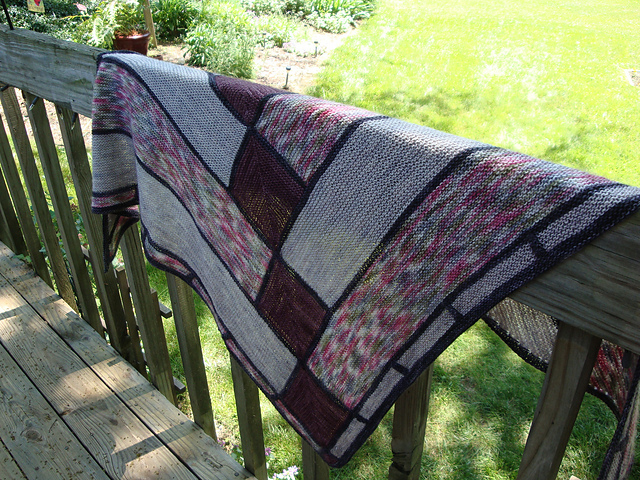 Believe me, in the hopes that the fit was only an optical illusion, making it fit was tried. Yank here, pull there. Even the delusion 'that S#!T will block right out' wasn't convincing. The only thing that was going to work was ripping back and redoing. And potentially ripping back and redoing ... again.
My guess is that both of those sweaters are currently in time out until the knitters have the heart to face them again. As of last night, the third sweater was almost done.
I can't face knitting a sweater right now.
The stress of moving my mom closer and keeping up with work and home has been, um, not good for my weight. Ice cream? Yes, please! Potato chips? You bet! Salad? Yeah, not so much.
 So while I have a sweater's worth of yarn, I don't know that I have a sweater's worth of yarn for one that would fit me right now. And I really couldn't face spending all that time knitting only to find out I didn't have enough.
Life's too complicated at the moment. Knitting is my happy place.
For the time being? I'll knit shawls. They fit.
Tuesday, September 3, 2013
A Tale of Two Young Men
Labor Day weekend, and time for the Muscular Dystrophy Telethon. As a child, I remember watching Jerry Lewis raise money, with the help of his celebrity friends, for the fight against MD. They were compelling and I was determined to do my part, because ... well, Jerry and his famous friends wanted me to.

Today, the fight for Muscular Dystrophy and Labor Day weekend have a much more personal place in my heart.
Meet Chris.
He's the one in the wheelchair.
 (The goofball next to him? That's Alex, my youngest son. Oh, and because he's a goofball, he decided that in this picture, from their high school graduation, it would be fun to give Chris bunny ears. And if you look closely, you'll notice that since Chris couldn't return the favor, Alex gave himself ears - or at least tried. Then there's that whole loser thing ... )

 Alex and Chris met in elementary school, when Chris got his first chair and needed someone to carry his books and assist him with the elevator. Alex was quiet and shy, not quite fitting in. The teacher thought that maybe this would help get Alex out of his shell.
 And thus began a lifelong friendship. On field trips, Alex would ride the wheelchair accessible bus with Chris. Alex spent a good portion of his summers with Chris doing crafts, playing video games, making rockets, exploring — you know, normal boy stuff. Alex accompanied Chris at the local MD telethons - even ending up on camera.
One of Alex's junior high teachers told us Alex needed to get some "normal" friends, she thought the friendship with Chris wasn't healthy. Say what?! Define 'normal' ... Define 'healthy' ...

For their last day of high school, when the senior class traditionally parades onto the school grounds in decorated cars, Alex decorated and drove the van so Chris could take part in it — I mean, who wouldn't rather drive a wheelchair mini van instead of a two door coupe at a high school event? They had a joint graduation party at Chris' house. When Alex went off to college, he looked at residence halls with an eye on which had elevators and would be accessible for Chris to visit.
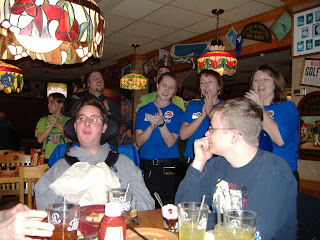 For Alex's first birthday, away from home, we surprised him with a dinner at Applebee's — selected for its accessibility. Ironically, in college, Alex encountered a group of students working to raise awareness that the university's historic academic buildings weren't accessible. They were blocking the door Alex was going to enter, telling him he needed to find the handicap entrance to better understand the needs and challenges of those in wheelchairs. From what I understand — the students got an earful and Alex used the door they were blocking.
 You see, where others saw a boy in a wheelchair, Alex saw a person. A person with special needs and limitations, but a person none the less. And eventually, that person, and his family, became our family. Shared holidays, end of school year bonfires, birthdays, outings, weekends ... what had started out as Alex helping a student, in elementary school, turned into something that none of us could have imagined.
 Alex surprised us, which shouldn't have surprised us. He said there was no where else he needed, or wanted, to be but with Chris. He went and helped Sue tend Chris, shh-hing visitors if Chris was sleeping. Never leaving his side all day and into the evening as visitors came and went (that's him in the background, keeping guard.) At one point I walked in and witnessed Sue and Alex working, as a team, to cool Chris down with cool wet towels, trying to make him as comfortable as possible.


Today, the fight for Muscular Dystrophy and Labor Day weekend have a much more personal place in my heart.
Meet Chris.
He's the one in the wheelchair.


 Alex and Chris met in elementary school, when Chris got his first chair and needed someone to carry his books and assist him with the elevator. Alex was quiet and shy, not quite fitting in. The teacher thought that maybe this would help get Alex out of his shell.
 And thus began a lifelong friendship. On field trips, Alex would ride the wheelchair accessible bus with Chris. Alex spent a good portion of his summers with Chris doing crafts, playing video games, making rockets, exploring — you know, normal boy stuff. Alex accompanied Chris at the local MD telethons - even ending up on camera.
One of Alex's junior high teachers told us Alex needed to get some "normal" friends, she thought the friendship with Chris wasn't healthy. Say what?! Define 'normal' ... Define 'healthy' ...

For their last day of high school, when the senior class traditionally parades onto the school grounds in decorated cars, Alex decorated and drove the van so Chris could take part in it — I mean, who wouldn't rather drive a wheelchair mini van instead of a two door coupe at a high school event? They had a joint graduation party at Chris' house. When Alex went off to college, he looked at residence halls with an eye on which had elevators and would be accessible for Chris to visit.
 For Alex's first birthday, away from home, we surprised him with a dinner at Applebee's — selected for its accessibility. Ironically, in college, Alex encountered a group of students working to raise awareness that the university's historic academic buildings weren't accessible. They were blocking the door Alex was going to enter, telling him he needed to find the handicap entrance to better understand the needs and challenges of those in wheelchairs. From what I understand — the students got an earful and Alex used the door they were blocking.
When Alex and Chris attended board game nights, Alex devised a way to hold Chris' cards so that Chris could participate when he could no longer use his hands.
And when it was time for Alex to graduate from college, he made sure special arrangements were made so that Chris could have seating on the field, and asked Sue, Chris' mom, to host his graduation party so Chris could be a part of it.
And when it was time for Alex to graduate from college, he made sure special arrangements were made so that Chris could have seating on the field, and asked Sue, Chris' mom, to host his graduation party so Chris could be a part of it.
Don't get me wrong, Alex wasn't a saintly kind of boy (a description Sue gave him) and doing this for show or brownie points. Alex and Chris had an extraordinary friendship that benefited both. Alex wasn't above telling Chris that just because he was in a wheelchair didn't mean he had the right to be a jerk. And he'd call Chris out if he thought he was being mean to his mom, reminding him that he depended on her and needed to be nicer (this may be why Sue thinks Alex is a saintly kind of boy. More on Sue later — she deserves her own entry.)
 You see, where others saw a boy in a wheelchair, Alex saw a person. A person with special needs and limitations, but a person none the less. And eventually, that person, and his family, became our family. Shared holidays, end of school year bonfires, birthdays, outings, weekends ... what had started out as Alex helping a student, in elementary school, turned into something that none of us could have imagined.
Throughout all of this was the underlying reality that Chris had Duchenne Muscular Dystrophy, a particularly cruel disease that affects mostly males and is faster in destroying the body's muscle. Chris' life expectancy was 18. There was no denying the inevitable.
When the boys were in high school, I'd try to bring up the subject with Alex — did he and Chris discuss what was coming? Alex would tell me "Mom, Chris and I don't talk about this. He has other people who want to talk to him about depressing stuff. We do happy and fun. I'm his friend. I'm focused on him today." So we braced ourselves. Convinced that when the time came, we were going to have to pick up the pieces.
Chris surprised us, which shouldn't have surprised us. He lived past 18, then 20, then 24... His spirits never flagged even when his body was giving up.
That was then.
On Saturday morning, September 3rd, 2011, I received a call from Sue telling me Chris was dying and he wanted to make sure Alex was told. She understood that Alex wasn't comfortable with death and didn't expect him to come, Chris just wanted to know that Alex knew. So I called Alex, then held my breath. Unsure of how Alex would respond.
 Alex surprised us, which shouldn't have surprised us. He said there was no where else he needed, or wanted, to be but with Chris. He went and helped Sue tend Chris, shh-hing visitors if Chris was sleeping. Never leaving his side all day and into the evening as visitors came and went (that's him in the background, keeping guard.) At one point I walked in and witnessed Sue and Alex working, as a team, to cool Chris down with cool wet towels, trying to make him as comfortable as possible.
Was this my son? Mopping the sweat off his friend?
It was about 6:00 that evening when Sue left Chris' room to alert someone else the end was near. After Sue had gone, Chris woke, asked Alex to stand where he could see him, and then said good-bye. Chris was 25.
Two years ago today, on the Saturday before the MD telethon, I watched, in awe, the strength of two young men. Two men who surprised us, first as boys, and now as men. One courageously coming to the end of his life ... the other courageously trying to ease that transition.
It was a rough day. My heart still breaks when I think of what my son experienced and yet I couldn't be prouder of the man Alex proved he was.
Because of his lifelong friendship with Chris.
A life that just wasn't long enough.
And so, this weekend, I make my annual donation to the Muscular Dystrophy Association and designate it for Duchenne research.
I do it out of love for two incredibly strong young men.
I do it in memory of Chris.
I do it in honor of Alex.
I do it in the hopes that this story won't be repeated in the not too distant future.

Tuesday, August 27, 2013
Paying Attention - To What?
And now, a dramatic reading from my elementary school report cards ... (ahem...)
Let us begin.
(I left out multiple comments from the same teacher. Seemed overkill when other teachers could help emphasize the point.)
Forty-nine years later, I have no idea what I was daydreaming about. I obviously did it. A lot.
Likely I was trying to find an answer — just not to the question at hand. Or, maybe ... I thought the answer was out the window.
And while I'm sure Science and Math were more important, I can clearly picture myself, sitting in a classroom, staring out the window — watching the outside world. To this day, it is a vivid image.
I can't picture what was on the blackboard (based on the report cards, it would be fair to deduce it was either Math or Science.)
Mrs. Harris would be proud of where I am today. After begging my parents to discuss, with me, overcoming my 'fault,' I did indeed make it through, not only, fifth grade (she was very concerned — I believe 'afraid' was the word she used) but high school, college and graduate school. I've had a successful (depending on the definition) career.
At some point, back then, I started to pay attention. My grades went from mediocre to those of an honor student. I learned that daydreaming was a waste of time and unproductive. That what was taking place external to me had more value than what was taking place inside of me, through my daydreams. I learned others had the answer. I didn't.
Sit down, shut up, do as you're told.
The answer is not out the window.
Pay attention.
But, sometimes what's going on inside of you is trying to tell you to pay attention to what's happening outside.
Some call it intuition, some call it a gut reaction. It's that nebulous thing you can't ... quite ... put ... your ... finger... on.
You are paying attention.
Just not to what others want you to pay attention to.
All the while believing your intuition isn't trustworthy, and others still have the answer.
Maybe 'they' were wrong. Maybe daydreaming isn't a waste of time. Maybe they don't have the answer. Maybe your intuition is on the mark.
So I sit in my office and stare out the window at the trees, the traffic and life that is out there ... knowing I should pay more attention to what is going on in the office and less attention to what's going on outside the office (see Miss Zachary, I can be taught, I just can't be forced to conform, even after all these years.)
Because maybe, the answer is out the window. And if I stare long enough, it will come to me.
Does that cloud look like an elephant to you?
P.S. I shared this before posting - and the first thing they said was "Interesting that at the end you say you can't be forced to conform. And yet, it's obvious you have." Must think on that.
Let us begin.
Grade the First
Leslie is a capable child. She is a daydreamer and this causes her to make careless mistakes.
Grade the Third
Leslie seems more concerned with the outside activities than with her schoolwork.
Grade the Fourth
She daydreams too much (with the caveat: Has creative ability)
Does not like the subject (Math) so daydreams while class is going on.
Grade the Fifth
Needs to pay more attention in class.
(I left out multiple comments from the same teacher. Seemed overkill when other teachers could help emphasize the point.)
Forty-nine years later, I have no idea what I was daydreaming about. I obviously did it. A lot.
Likely I was trying to find an answer — just not to the question at hand. Or, maybe ... I thought the answer was out the window.
And while I'm sure Science and Math were more important, I can clearly picture myself, sitting in a classroom, staring out the window — watching the outside world. To this day, it is a vivid image.
I can't picture what was on the blackboard (based on the report cards, it would be fair to deduce it was either Math or Science.)
Mrs. Harris would be proud of where I am today. After begging my parents to discuss, with me, overcoming my 'fault,' I did indeed make it through, not only, fifth grade (she was very concerned — I believe 'afraid' was the word she used) but high school, college and graduate school. I've had a successful (depending on the definition) career.
At some point, back then, I started to pay attention. My grades went from mediocre to those of an honor student. I learned that daydreaming was a waste of time and unproductive. That what was taking place external to me had more value than what was taking place inside of me, through my daydreams. I learned others had the answer. I didn't.
Sit down, shut up, do as you're told.
The answer is not out the window.
Pay attention.
But, sometimes what's going on inside of you is trying to tell you to pay attention to what's happening outside.
Some call it intuition, some call it a gut reaction. It's that nebulous thing you can't ... quite ... put ... your ... finger... on.
You are paying attention.
Just not to what others want you to pay attention to.
All the while believing your intuition isn't trustworthy, and others still have the answer.
Maybe 'they' were wrong. Maybe daydreaming isn't a waste of time. Maybe they don't have the answer. Maybe your intuition is on the mark.
So I sit in my office and stare out the window at the trees, the traffic and life that is out there ... knowing I should pay more attention to what is going on in the office and less attention to what's going on outside the office (see Miss Zachary, I can be taught, I just can't be forced to conform, even after all these years.)
Because maybe, the answer is out the window. And if I stare long enough, it will come to me.
Does that cloud look like an elephant to you?
P.S. I shared this before posting - and the first thing they said was "Interesting that at the end you say you can't be forced to conform. And yet, it's obvious you have." Must think on that.
Sunday, August 25, 2013
My Father, Myself - Part the Second
Meet my dad -

 These are prized pictures. Albert Stanley was rarely photographed.


Yes, my dad wore cameras the way most people wear watches.
Dad was a geek before anyone knew there were such things. He would have LOVED our digital, virtual, plugged in world. I guarantee it.
They say past behavior can predict future actions (or something like that), so while I will never have hard evidence to prove my hypothesis, I can only speculate on the number of 'toys' dad would have. The answer, based the storage tub full of camera equipment I inherited, would be a s#*t load.
No, let me take that back ... I only inherited some of it, when he died. The rest came into my possession when he grew tired of the camera/lens/flash or the latest, greatest, new and improved thing was released. Doesn't this sound like someone who would love technology that is obsolete the minute it comes out and begs to be upgraded?
As it turned out, photography was something my father and I could share (I was just smart enough to let him do all the shopping.)
While my dad had always enjoyed taking pictures, it wasn't until I had gone off to college that he got into it with a vengeance. Because of his health, he had retired early and photography filled that creative void when he was no longer designing for steel mills. (I guess designing mill buildings can be creative — if you're into that kind of thing. I can't say I ever saw the beauty in them, but then, I can't say I was ever all that interested in steel mills period.)
In my final semester of college, I took a black & white photography class. My dad was over the moon excited. He was more than willing to go on 'field trips' with me to play with the cameras and lenses. We'd both record shutter speeds, apertures, film used, and lighting conditions so that we could go back and dissect why the pictures came out the way they did. I still have many of those records and proof sheets — his and mine. I don't know why...
Imagine my father's delight when I took a job with a professional photography lab and then as a manager of a camera store. And he could barely contain his excitement when I started doing B&W developing and printing in my basement.
(To this day, the smell of Dektol brings back fond memories ... like spending a Friday evening, during college, with a friend in a darkroom to see what developed. Thirty-three years of marriage later, we're still trying to figure it out! But on that Friday night, it was homework for my photography class ... what were you thinking?)
At some point, I gave up photography as a hobby. The camera equipment was banished to the basement. Maybe because my dad wasn't there to share it with anymore. Maybe because, with two small children, a point and shoot was easier. Maybe because, at some point, I decided I had no photographic talent and abandoned it.
Who knows?

The shutter bug has bit, again, and I'm on the hunt for a digital single lens reflex (DSLR). I know what the popular brands are — Canon, Nikon — but these are not what I'll get. Mine will be a Pentax. Because they are still around ... because my dad was a Pentax man ... because I still have a s#*t load of inherited lenses.
Mostly because I will be able to hear my dad's voice. I know he'll be there, guiding and loving every digital moment. And I'll enjoy the re-connection — to photography and my father.
Once again I will be reminded of his favorite, and oft used, expression: "I've taken hundreds of great pictures. Too bad there wasn't any film in the camera." I wonder how he'd deal with the fact that cameras don't require film these days and those 'great pictures' would be captured?
I'm guessing the delete button would have been his friend.
I know it will be mine.
Now, off to find a camera and see what develops ...


Can you guess why?


Yes, my dad wore cameras the way most people wear watches.
Dad was a geek before anyone knew there were such things. He would have LOVED our digital, virtual, plugged in world. I guarantee it.
They say past behavior can predict future actions (or something like that), so while I will never have hard evidence to prove my hypothesis, I can only speculate on the number of 'toys' dad would have. The answer, based the storage tub full of camera equipment I inherited, would be a s#*t load.
No, let me take that back ... I only inherited some of it, when he died. The rest came into my possession when he grew tired of the camera/lens/flash or the latest, greatest, new and improved thing was released. Doesn't this sound like someone who would love technology that is obsolete the minute it comes out and begs to be upgraded?
As it turned out, photography was something my father and I could share (I was just smart enough to let him do all the shopping.)
While my dad had always enjoyed taking pictures, it wasn't until I had gone off to college that he got into it with a vengeance. Because of his health, he had retired early and photography filled that creative void when he was no longer designing for steel mills. (I guess designing mill buildings can be creative — if you're into that kind of thing. I can't say I ever saw the beauty in them, but then, I can't say I was ever all that interested in steel mills period.)
In my final semester of college, I took a black & white photography class. My dad was over the moon excited. He was more than willing to go on 'field trips' with me to play with the cameras and lenses. We'd both record shutter speeds, apertures, film used, and lighting conditions so that we could go back and dissect why the pictures came out the way they did. I still have many of those records and proof sheets — his and mine. I don't know why...
Imagine my father's delight when I took a job with a professional photography lab and then as a manager of a camera store. And he could barely contain his excitement when I started doing B&W developing and printing in my basement.
(To this day, the smell of Dektol brings back fond memories ... like spending a Friday evening, during college, with a friend in a darkroom to see what developed. Thirty-three years of marriage later, we're still trying to figure it out! But on that Friday night, it was homework for my photography class ... what were you thinking?)
At some point, I gave up photography as a hobby. The camera equipment was banished to the basement. Maybe because my dad wasn't there to share it with anymore. Maybe because, with two small children, a point and shoot was easier. Maybe because, at some point, I decided I had no photographic talent and abandoned it.
Who knows?

The shutter bug has bit, again, and I'm on the hunt for a digital single lens reflex (DSLR). I know what the popular brands are — Canon, Nikon — but these are not what I'll get. Mine will be a Pentax. Because they are still around ... because my dad was a Pentax man ... because I still have a s#*t load of inherited lenses.
Mostly because I will be able to hear my dad's voice. I know he'll be there, guiding and loving every digital moment. And I'll enjoy the re-connection — to photography and my father.
Once again I will be reminded of his favorite, and oft used, expression: "I've taken hundreds of great pictures. Too bad there wasn't any film in the camera." I wonder how he'd deal with the fact that cameras don't require film these days and those 'great pictures' would be captured?
I'm guessing the delete button would have been his friend.
I know it will be mine.
Now, off to find a camera and see what develops ...
Friday, August 16, 2013
I Can Be Taught... (StitchesMidwest Part 2)
Well, kind of.
If nothing else, I'm good at paying attention and knowing what was said. I may not be as good putting it into practice.
First, let me start by saying that the teachers at StitchesMidwest were AWESOME. They knew their topics and were good at communicating to their audience. As a recovering corporate trainer, I can tell you, this is difficult even with good trainer training. So please understand, as I sing their praises, I was a tough and discerning observer, not only of the subject, but also how it was being taught. Subject matter experts do not necessarily know how to teach (why do you think there are corporate trainers?)
And these were Subject Matter Experts Extraordinaire.
My first class was a short market session on Continental knitting. For the non-knitters here: there are generally two techniques for knitting. English style is done by 'throwing' the yarn over the needle with the right hand. Continental is 'picking' the yarn being held in the left hand. Neither is wrong, just different, and allows for changing up how the hands are being utilized.
Kellie Nuss was very patient in working with each of us, watching how we held our yarn, managed our tension and made the movements for both the knit and purl stitches. (I got the knit stitch, no problem. Purl stitch? Problem.) Kellie demoed by using large needles and bulky yarn that made watching her hand movements easier, and she circulated around the group so we got different views of those movements. So while I didn't master Continental knitting, I do feel confident enough to keep practicing. And for a market session, that's all I could ask.
My next class was a three hour session on the Ergonomics of Knitting. Now this sounds like a snoozer, right? But I needed to figure out how to lessen the fatigue in my hands and shoulders as I knit — so I went. And let me tell you, Carson Demers knows his stuff (and he should. He's a physical therapist and a Certified Ergonomics Assessment Specialist) and how to make it as entertaining as one can make learning about posture. He dispelled the myth that Continental knitting was faster than English, depending on who was doing the knitting (I would not be fast at Continental, at least not yet) but that it was a way to ease problems that arise from repetitive motion by switching up how the hands work the yarn and needles. And he explained why knitting 'injuries' are far more prevalent today than in years past (computers, anyone?)
Who knew one of the worst things we, as knitters, could do was sit smooshed up in our favorite comfy arm chair, feet tucked under us, to knit? That it will only add to our pain in the long run? Turns out, we're not doing ourselves any favors by propping our arms on a table or chair arms either.
I learned the benefits of square knitting needles, using circulars, having multiple projects going at the same time on a variety of needle sizes and yarn weights as well as the reason I shouldn't sit knitting for hours at a time. And holding a warm cup of tea, before starting to knit, is a good thing.
After that three hour class, I still find myself assessing how I can ensure that my "happy place" (knitting) doesn't cause me pain ... and next time I'm taking Carson's Swatch-buckling class so I can learn to knit and walk at the same time.
Enough for today — next week I'll gush about my class with Franklin Habit who was every bit as lovely as I had hoped he'd be.
Thursday, August 15, 2013
I Am a Sheep in Knitter's Clothing
Dear SpaceCadet®,
Your enthusiasm is catchy. You wrote in your blog about loving the addictive Zoom Loom. How you couldn't put it down. That it was so much fun. And it was a great way to use mini-skeins or leftover yarn.
Turns out, I am a sheep. (I'd have said lemming, but that didn't seem to fit in the fiber community.)
So ... Now I have one ...

... and not sure what to do with it?
Just so you know, I have local enablers. A gaggle of them that are MORE than willing to help me spend money. Do I really need someone enabling me from Pittsburgh?
Now, to be fair, I trust your opinion because, well ... how can I not trust someone who dyes some of the most beautiful yarn I've seen? The creator of my very first yarn club (yes I am a proud and loyal member of the InterStellar Yarn Alliance.)
When I bought the loom, at StitchesMidwest, the first thing my travelingenablers companions said was "I had one of those as a kid. To make potholders."
So did I!
Maybe that's why it called to me from across the marketplace. Maybe it wasn't you. No, I distinctly remember saying "OMG, that's the thing the SpaceCadet® loved." Maybe I'm just rationalizing by pretending it's nostalgia.
When I got the loom home, my husband took one look at it and said "wow, my grandfather used to make potholders on something just like that."
Enough with the potholders already!
So I've spent time researching what can be done with a Zoom Loom. I was a bit discouraged when the first thing I found were coasters. Aren't those just miniature potholders? Things picked up a bit when I started looking at what others were doing by joining the squares — like a blanket. Then I realized there were YouTube® videos, websites, Pinterest® boards, and Ravelry® groups. All around the topic of weaving on a small loom.
Who Knew? Turns out this thing is baaaad. (Good thing it's sheep and not lemmings. I have no idea what a lemming sounds like.)
So I suppose it's time to pull out some yarn (not yours, right now. Maybe after I've practiced - I'm not wasting the good stuff.) I'll keep you posted on how it goes. Or you'll know when I join the mini-skein club. But one thing at a time.
What's the worse that's can happen? I'll have a lot of potholders and coasters. It's all good.
Your's in Fiber,
Leslie
P.S. - We had Show and Tell last night at the yarn store. Everyone wanted to know what I was going to do with the potholder maker. I am soooo going to show them!
Your enthusiasm is catchy. You wrote in your blog about loving the addictive Zoom Loom. How you couldn't put it down. That it was so much fun. And it was a great way to use mini-skeins or leftover yarn.
Turns out, I am a sheep. (I'd have said lemming, but that didn't seem to fit in the fiber community.)
So ... Now I have one ...

... and not sure what to do with it?
Just so you know, I have local enablers. A gaggle of them that are MORE than willing to help me spend money. Do I really need someone enabling me from Pittsburgh?
Now, to be fair, I trust your opinion because, well ... how can I not trust someone who dyes some of the most beautiful yarn I've seen? The creator of my very first yarn club (yes I am a proud and loyal member of the InterStellar Yarn Alliance.)
When I bought the loom, at StitchesMidwest, the first thing my traveling
So did I!
Maybe that's why it called to me from across the marketplace. Maybe it wasn't you. No, I distinctly remember saying "OMG, that's the thing the SpaceCadet® loved." Maybe I'm just rationalizing by pretending it's nostalgia.
When I got the loom home, my husband took one look at it and said "wow, my grandfather used to make potholders on something just like that."
Enough with the potholders already!
So I've spent time researching what can be done with a Zoom Loom. I was a bit discouraged when the first thing I found were coasters. Aren't those just miniature potholders? Things picked up a bit when I started looking at what others were doing by joining the squares — like a blanket. Then I realized there were YouTube® videos, websites, Pinterest® boards, and Ravelry® groups. All around the topic of weaving on a small loom.
Who Knew? Turns out this thing is baaaad. (Good thing it's sheep and not lemmings. I have no idea what a lemming sounds like.)
So I suppose it's time to pull out some yarn (not yours, right now. Maybe after I've practiced - I'm not wasting the good stuff.) I'll keep you posted on how it goes. Or you'll know when I join the mini-skein club. But one thing at a time.
What's the worse that's can happen? I'll have a lot of potholders and coasters. It's all good.
Your's in Fiber,
Leslie
P.S. - We had Show and Tell last night at the yarn store. Everyone wanted to know what I was going to do with the potholder maker. I am soooo going to show them!
Subscribe to:
Posts (Atom)